Running a window treatment business involves much more than keeping a list of customers and appointments.
A retailer may need to capture a new lead, schedule an in-home consultation, measure multiple windows, configure products, create an accurate quote, collect payment, convert the quote into an order, submit that order to a manufacturer, track its progress, schedule installation, and follow up with the customer—all while keeping the rest of the business moving.
That is where window treatment business software comes in.
Window treatment business software is technology designed to help window covering retailers manage the specialized workflows involved in selling, ordering, and installing custom window treatments. Depending on the platform, it can combine functions such as CRM, calendars, in-home quoting, electronic ordering, payment processing, order tracking, reporting, and other business-management tools.
While a traditional CRM can help organize leads and customer communication, industry-specific business software can go considerably further. The goal is to connect the different stages of a window treatment sale so retailers spend less time moving information between disconnected systems and more time serving customers and growing their businesses.
What Does Window Treatment Business Software Do?
Every platform is different, but comprehensive window treatment software should help manage the customer journey from the initial inquiry through the completed job.
That can include:
- Managing leads and customer records
- Scheduling consultations and installations
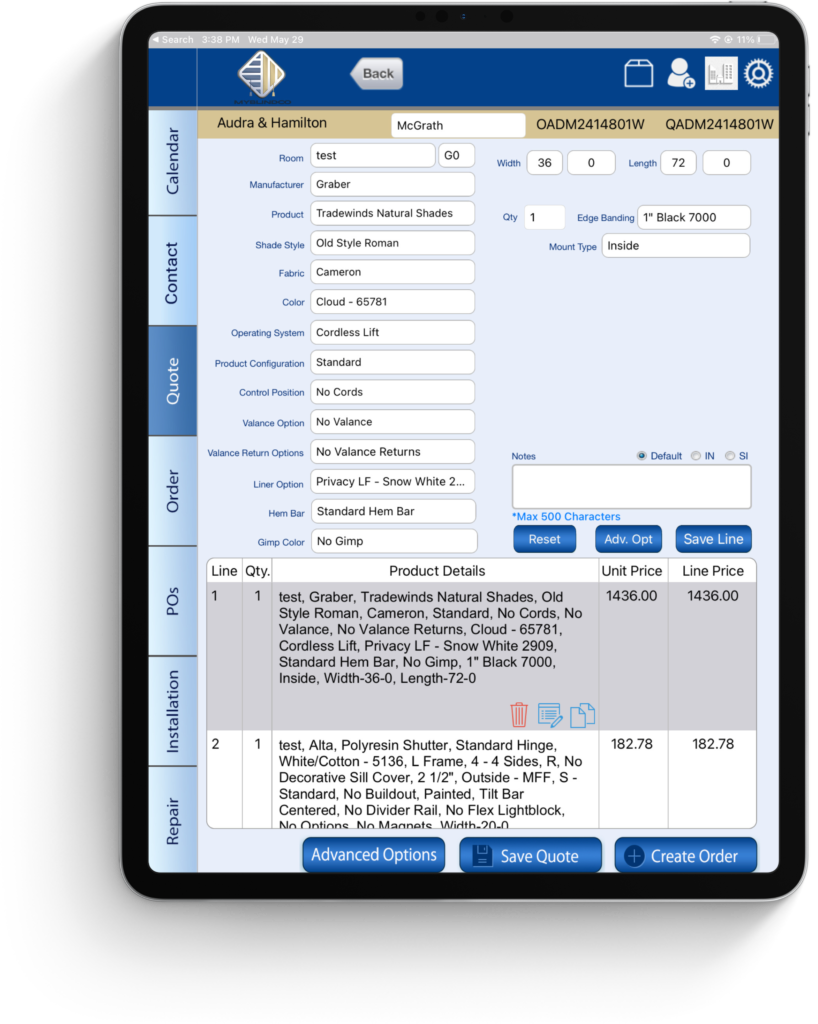
- Creating quotes during in-home appointments
- Accessing quoting tools without an internet connection
- Managing product and pricing information
- Converting accepted quotes into orders
- Electronically submitting orders
- Tracking orders throughout the sales process
- Processing customer payments
- Managing sales and installation workflows
- Creating reports and monitoring business performance
- Following up with leads, quoted customers, and past customers
For window treatment retailers, the advantage is not simply having more features. It is having those features designed around the way a window treatment business actually operates.
Window Treatment Software vs. a Traditional CRM
The terms CRM and business software are sometimes used interchangeably, but they aren’t necessarily the same thing.
CRM stands for customer relationship management. Traditional CRM software generally focuses on information such as contacts, leads, communications, appointments, opportunities, and sales pipelines.
Those functions are valuable to a window treatment retailer—but they’re only one part of the job.
A window treatment salesperson also needs to know what the customer is purchasing, the measurements for each opening, how the product should be configured, what it costs, whether a deposit has been collected, whether an order has been placed, where that order is in the process, and when the installation should occur.
That’s why industry-specific software can be valuable.
Instead of asking a general-purpose CRM to accommodate a specialized workflow, window treatment business software can be built around the process from the beginning.
MyBlindCo, for example, is an all-in-one software and marketing solution built specifically for the window treatment industry by window treatment professionals. Its retailer software combines customer and business management with tools for quoting, ordering, payments, tracking, reporting, and more.
In-Home Quoting Is a Major Part of the Retailer Workflow
Quoting custom window treatments is considerably more complicated than entering a quantity and price.
A salesperson may be working with multiple rooms, numerous openings, different manufacturers, products, sizes, options, and configurations. The ability to build an accurate quote efficiently during a consultation can make the sales process easier for both the retailer and the customer.
This is one area where software designed specifically for the window treatment industry can stand apart from a standard CRM.
With MyBlindCo, retailers can create quotes while working with customers in the home. The software is also accessible offline, allowing professionals to continue working when reliable internet access isn’t available.
That matters in the field. An in-home sales tool shouldn’t become unusable simply because a customer’s Wi-Fi is weak or a salesperson is working somewhere with poor connectivity.
The ability to work from virtually anywhere is particularly valuable for window treatment professionals whose “office” frequently changes from one customer’s home to the next.
CRM and Customer Management
Although window treatment software can extend well beyond CRM, customer management is still an important part of the system.
Retailers need a reliable place to maintain customer information and understand where each person stands in the sales process.
A connected system can help a business answer questions such as:
- Who are our newest leads?
- Which customers have consultations scheduled?
- Which customers have already received quotes?
- Which quotes still need follow-up?
- Which customers have placed an order?
- Which jobs are waiting for products?
- Which installations need to be scheduled?
- Which customers have completed their projects?
Instead of relying on someone’s memory, handwritten notes, multiple spreadsheets, or disconnected applications, the business can create a more organized workflow.
MyBlindCo’s retailer platform includes Calendar & CRM functionality alongside its quoting and business-management tools, helping connect customer information with the operational side of the sale.
From Quote to Order Without Starting Over
Creating the quote is only one stage of the process.
Once a customer says yes, the information already collected should help move the job forward.
Window treatment business software can reduce the need to repeatedly enter the same information as a job progresses from quote to sale and ultimately to order.
MyBlindCo allows retailers to convert quotes into orders and streamline the ordering process with electronic ordering, real-time tracking, and reporting.
That connection is important because custom window treatments involve detailed information. Every time information is manually copied from one system into another, another opportunity for wasted time or an avoidable mistake is introduced.
A connected quote-to-order process helps keep the information associated with the job as it moves forward.
Electronic Ordering Can Connect Retailers and Manufacturers
Electronic ordering becomes even more valuable when the retailer’s software can connect directly with participating manufacturers.
Rather than treating retailer software and manufacturer software as completely separate systems, MyBlindCo can connect both sides of the relationship.
Manufacturers using MyBlindCo’s manufacturing technology can grant their dealers access to their products through the MyBlindCo retailer application. Dealers can then quote those products and submit orders electronically into the manufacturer’s MyBlindCo portal.
For retailers, that can create a more streamlined path from:
Product → Quote → Sale → Order → Manufacturer
For manufacturers, the submitted order enters a system designed to help manage the next stages of fulfillment and production.
This connected dealer-manufacturer workflow is one example of why window treatment business software can encompass much more than customer relationship management.
Payment Processing Within the Business Workflow
Payment is another important step that can become disconnected when businesses rely on several unrelated tools.
Window treatment retailers commonly collect deposits and additional payments as projects progress. Having payment capabilities within the business-management environment can make it easier to keep financial activity associated with the correct customer and order.
MyBlindCo includes in-app payment processing, allowing retailers to incorporate payment collection into the same broader workflow they use to manage their jobs.
The goal is convenience: fewer disconnected steps for the business and a smoother process for the customer.
Order Tracking and Job Management
After an order is placed, the customer relationship doesn’t stop.
The business needs to know what is happening with the job so employees can determine what needs attention next.
That may include monitoring orders, receiving products, coordinating installation, and keeping customers informed.
A strong business-management platform creates visibility across these stages instead of allowing jobs to disappear into separate spreadsheets, inboxes, or individual employees’ notes.
Real-time tracking can also help teams answer customer questions more confidently because information about the job is easier to locate.
Calendars Should Connect With the Rest of the Business
Calendars may seem like a simple feature, but scheduling is deeply connected to the workflow of a window treatment retailer.
There are initial consultations, follow-up appointments, measurements, service appointments, installations, and other events to coordinate.
When scheduling information exists alongside customer and job information, employees can better understand not only when something is happening, but also who the customer is and where that job currently stands.
This is another reason a connected platform can be more useful than assembling a collection of unrelated applications.
Reporting Helps Retailers Understand Their Businesses
Software shouldn’t only record what has already happened. It should also help business owners understand what is happening.
Reporting can give retailers greater visibility into their operations and sales performance.
Depending on the information being tracked, business owners may want to understand:
- How much business is being quoted?
- How many quotes are becoming orders?
- What jobs are currently in progress?
- Which opportunities are still open?
- Where are customers in the sales process?
- What is happening across the business?
MyBlindCo includes comprehensive reporting alongside its quoting, ordering, tracking, CRM, calendar, and payment capabilities.
When these activities happen within a connected platform, the data can provide a more complete picture than information scattered among several unrelated systems.
What About Marketing?
Managing existing customers and jobs is important, but retailers also need a consistent way to attract new customers and stay connected with the people already in their database.
This is another area where MyBlindCo extends beyond traditional window treatment business software.
In addition to its retailer and manufacturer technology, MyBlindCo provides specialized marketing services for window treatment businesses.
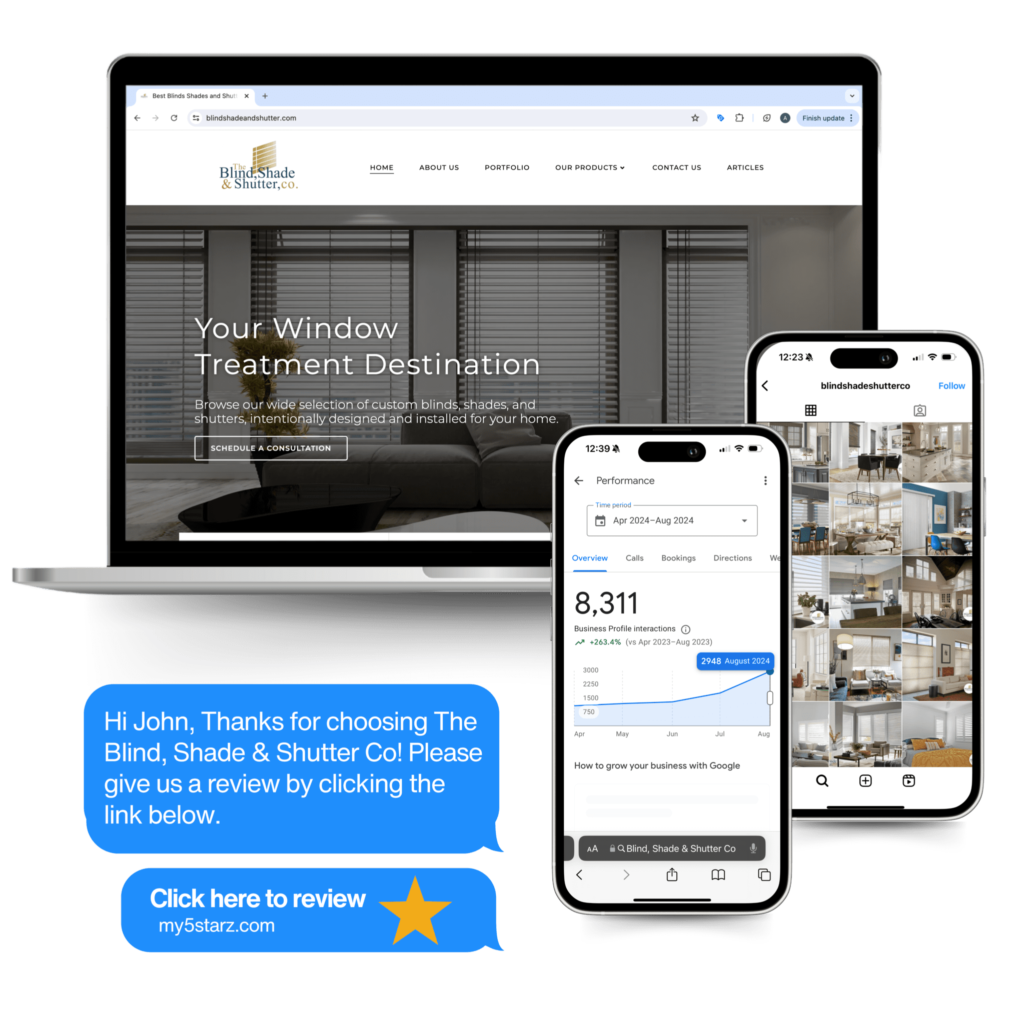
These services include search engine optimization and blogging, local SEO, Google Ads management, social media management, website development, and my5starz—an all-in-one marketing and CRM platform powered by HighLevel.
my5starz can complement the operational side of MyBlindCo by helping businesses manage marketing communication and customer follow-up.
For example, window treatment businesses can use automated communication to stay in touch with new leads, follow up with customers who have received quotes, communicate throughout the sales process, request reviews, and maintain relationships with previous customers.
The broader idea is to connect two sides of running a successful window treatment company:
Managing the business you already have and marketing the business you want to generate.
Why Industry-Specific Software Matters
There are many excellent general business applications available today. But window treatment retailers have requirements that aren’t common to every service business.
Custom window coverings involve products, options, measurements, pricing, quoting, ordering, manufacturers, installations, and numerous steps between the initial lead and completed project.
Software built specifically for this environment doesn’t have to guess what that workflow looks like.
MyBlindCo was built by window treatment professionals, and its team brings more than 80 years of combined window treatment industry experience to the platform.
Just as importantly, MyBlindCo isn’t software created for an industry its developers never encounter outside of a product meeting. The platform is built by professionals who still actively use it in the field.
That real-world experience helps inform the practical details that matter when software is being used during an actual workday—whether that’s creating an in-home quote, accessing information without internet connectivity, processing an order, or managing the next stage of a customer project.
What Should Retailers Look for in Window Treatment Business Software?
The right platform depends on the individual business, but retailers evaluating software should look beyond a simple feature checklist.
Consider how the platform fits the complete workflow.
Can you use it while you’re sitting in a customer’s home?
Can you continue quoting if you lose internet access?
Can customer information remain connected to the quote and order?
Can you convert a quote into an order without recreating the job?
Can orders be submitted electronically?
Can you collect payments?
Can your team track what’s happening with an order?
Can you manage appointments and customers?
Can you access useful business reporting?
Can the platform connect you with the manufacturers whose products you sell?
And when you need help, can you reach someone who understands both the software and the window treatment industry?
Those questions often reveal more about the practical value of a platform than simply counting how many features appear on a product page.
Software Should Make the Workday Simpler
Technology is only useful if people can actually use it.
Window treatment professionals are often working in customers’ homes, traveling between appointments, communicating with manufacturers, managing employees, checking orders, and handling dozens of other responsibilities.
Software shouldn’t make those responsibilities more complicated.
MyBlindCo is designed to be convenient and easy to use while bringing important parts of the retailer workflow together in one place. And when users need assistance, MyBlindCo provides human, U.S.-based customer service rather than leaving businesses to navigate everything on their own.
That combination of technology and industry knowledge is particularly important in a specialized field where the person asking for help may need someone who understands not only the software, but the business process behind it.
An All-in-One Approach to the Window Treatment Industry
The definition of window treatment business software is expanding.
For retailers, the right technology can help manage much more than a customer database. It can support the process from the first interaction with a potential customer through quoting, ordering, payment, tracking, installation, reporting, follow-up, and future marketing.
MyBlindCo takes that concept further by creating a connected ecosystem for the window treatment industry.
Its retailer software provides in-home quoting and business-management tools.
Its manufacturer software connects manufacturers and dealers while providing technology for order and operational management.
And its marketing services help window treatment businesses attract new customers, strengthen their online presence, manage leads, automate communication, and stay connected with existing customers.
Rather than adapting a generic system to fit the window treatment industry, MyBlindCo was built specifically around it.
For window treatment retailers looking for a platform that understands both the technology and the industry behind it, MyBlindCo brings decades of hands-on experience into one connected software and marketing ecosystem.
Frequently Asked Questions About Window Treatment Business Software
What is window treatment business software?
Window treatment business software is technology designed to help window covering professionals manage industry-specific processes such as customer management, in-home quoting, scheduling, ordering, payments, order tracking, reporting, and other parts of the sales and fulfillment process.
Is window treatment business software the same as a CRM?
Not necessarily. CRM is generally focused on managing customer relationships, leads, communications, and sales opportunities. Comprehensive window treatment business software can include CRM functionality while also handling specialized processes such as product quoting, electronic ordering, payments, order tracking, and other operational tasks.
Can window treatment software be used for in-home quoting?
Yes. Software designed for window treatment retailers can provide quoting capabilities for sales professionals working directly in customers’ homes. MyBlindCo’s retailer software supports in-home quote creation and can be accessed offline, making it useful when a reliable internet connection isn’t available.
Can window treatment software connect dealers with manufacturers?
Some industry-specific systems can. MyBlindCo connects participating manufacturers and their dealers through its retailer and manufacturer platforms. Manufacturers can make their products available to dealers using MyBlindCo, allowing those dealers to quote products and electronically submit orders into the manufacturer’s portal.
Can window treatment software process customer payments?
Payment functionality depends on the platform. MyBlindCo includes in-app payment processing as part of its retailer business-management software.
Does window treatment software include marketing?
Not every platform does. MyBlindCo combines its industry-specific software ecosystem with specialized marketing services for window treatment businesses, including SEO, local SEO, my5starz powered by HighLevel, Google Ads management, social media management, website development, and additional marketing support.
Why use software built specifically for the window treatment industry?
Industry-specific software can account for workflows that general business software may not handle natively, including custom-product quoting, measurements and configurations, electronic ordering, manufacturer relationships, order tracking, and installation-related processes. MyBlindCo was built by window treatment professionals and is backed by a team with more than 80 years of combined industry experience.
What is MyBlindCo?
MyBlindCo is an all-in-one software and marketing solution built specifically for the window treatment industry by window treatment professionals. Its connected ecosystem includes in-home quoting and business-management software for retailers, dealer and order-management technology for manufacturers, and specialized marketing services for window treatment businesses.
Ready to See How MyBlindCo Can Work for Your Business?
Every window treatment business operates a little differently. Schedule a custom demo of MyBlindCo to see how our all-in-one software can fit into your workflow—from in-home quoting and customer management to electronic ordering, payments, tracking, reporting, and more. We’ll walk you through the tools most relevant to your business and answer your questions along the way.
No responses yet